Equal Area Criterion
To determine the maximum permissible increase in mechanical power input for system stability.
Definition in a Textbook
Source: 1 (p831, first edition)
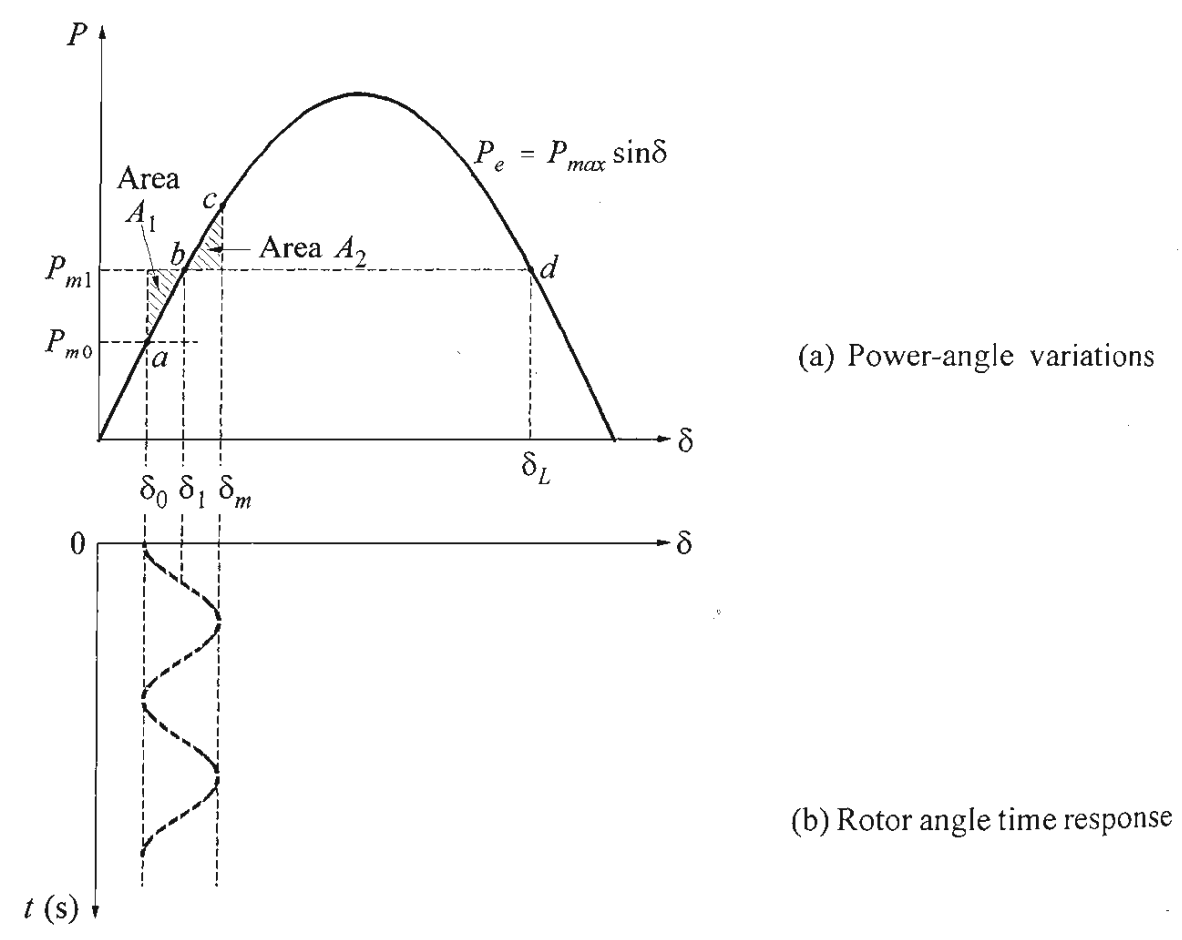
Fig. 13.14 Response to a step change in mechanical power input (from 1)
The equal-area criterion is useful in determining the maximum permissible increase in \(P_{m}\) for the system illustrated in Figure 13.14. Stability is maintained only if an area \(A_{2}\) at least equal to \(A_{1}\) can be located above \(P_{m}\). If \(A_{1} > A_{2}\), then the rotor angle \(\delta\) will exceed its critical value, and stability will be lost. For \(\delta > \delta_{\max}\), \(P_{m}\) exceeds \(P_{e}\), leading to net acceleration rather than deceleration.
Tip
Another earlier reference to the Equal Area Criterion can be found in 2.
Last modified: 2025-11-01
Related: extended-equal-area-criterion
← Energy Reserve · Expected Unserved Energy →
-
Kundur, Prabha (1994). Power System Stability and Control. ↩↩↩
-
Dahl, Otto Gustav Colbiornsen (1935). Stability of the General 2-Machine System. https://doi.org/10.1109/T-AIEE.1935.5056954 ↩